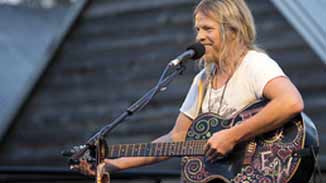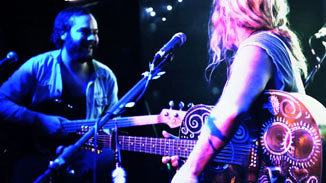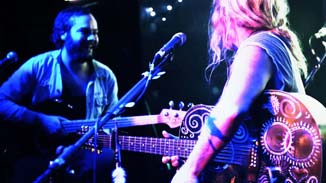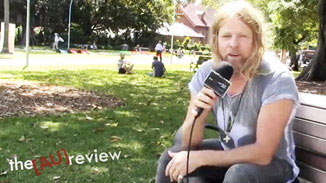

From the deserts of Rajasthan to the red sands of WA! Now back in Sydney finalising songs and mixes for a new album, Visit and join Eli Wolfes Facebook page here. After trekking through India in February this year—which saw him jam with desert locals, visit underprivileged schools and meet more gurus than most would meet in a lifetime—journey man Eli Wolfe is on the road again here in Australia.
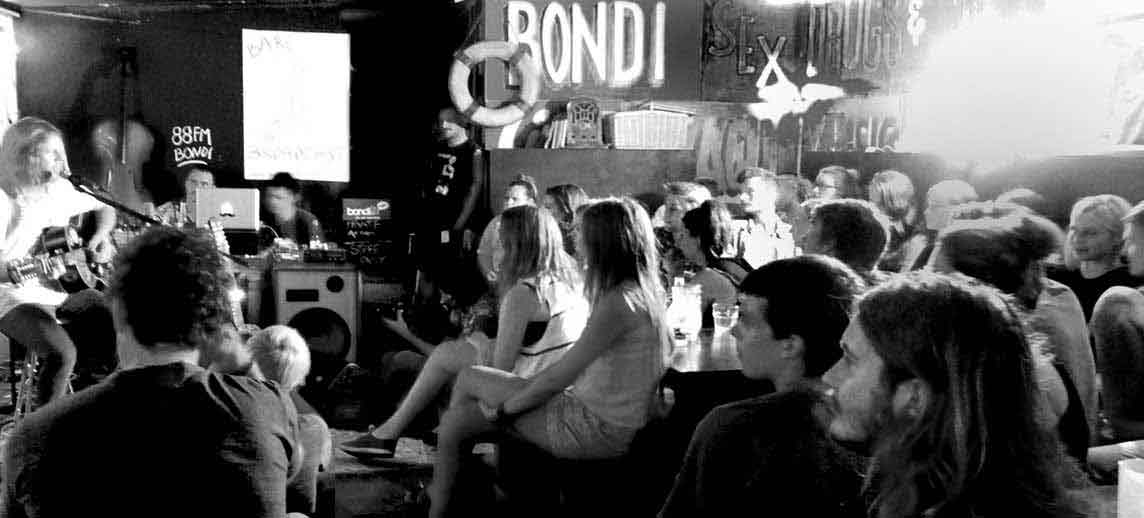
On Fri 4 Sept Eli WOlfe played in support of Askars Australian tour with a show at the Sydney Uni Manning Bar as part of the Verge Arts Festival, an amazing event. On Fri 25 Sept he played a special in-store show at Allans Music Sydney before heading off on tour the following day. NEW SINGLE He arrived home with several different India instruments to master, “made out of all kinds of crazy things like horse hair, goat skin, coconuts, pumpkins and stone.” This website shall be updated with new imagery, songs, lyrics and tour blogs. Have a great day and see you at a show somewhere soon!
Eli Wolfe, Mount Abu, India 2009 Mount Abu was the home of many saints and sages in the old days. Legend has it that all the 330 million gods and goddesses of the Hindu pantheon used to visit this holy mountain. It is also the place where the great saint Vashishth lived and performed a yagna (sacrificial worship on a fire pit) to create four Agnikula (four clans of fire) to protect the earth from demons. The yagna was supposed to have been performed near a natural spring, which emerged from a rock shaped like a cow's head. According to another legend, once sage Vashishth's cow Nandini was trapped in a deep gorge and could not free herself. The sage appealed to Lord Shiva for assistance. The Lord sent Saraswati, the divine stream, to help flood the gorge so that the cow could float up. Vashishth then decided to ensure that such mishaps did not occur in future. He asked the youngest son of Himalaya, the king of mountains to fill the chasm permanently. This he did with the assistance of Arbud, the mighty snake. This spot came to be known as Mount Arbud and was later changed to its present form - Mount Abu. This place is held in reverence by Jains as well since Jain scriptures record that Lord Mahavira, the 24th Jain Tirthankar (spiritual leader), also visited Mount Abu and blessed the city Eli Wolfe endorsed by Maton Guitars
FURTHER INTERESTING READING Below are paragraphs you can read if you wish, that will offer an 'insight' to the various symbols mentioned in different Eli Wolfe songs, artwork and ideas, etc. At the start I have placed a few interesting descriptives that outline terms used in explaining the expression sought in the art and music, in their many, multifaceted forms. Then a relative word and its documented and explored usage as an image or symbol through human time is used to further explore ideas. On an interesting sublevel of awareness, dreams and or heightened lucid dream states, can leave a strong impression on our day to day existence, conjuring imagery and actual experience that is not so easily defined in terms of social, 'westernized', communal interactions. So often, this aspect of communication and psychological exploration is deemed nonsense and not beneficial to the analytical functioning of our heavily 'digitized' consumer orientated lives. Afterall, the entire human community being aware, strong and clear in evaluating themselves and their external environment from a nurturing perspective does not lead to the necessary emotional hunger or sales of packaged happiness (and the elaborate ladder of hierarchy that is instilled from our early years,) that is needed to drive the mighty dollar wheel. Anyway....... Imagery and logos/symbols ( phonetic forms) are the basis for communicating the understanding of an entity, form, or time of collective importance,(ceremonic). Communicating the most with the least, (if delivered well), the logo is the all powerful gel that binds people together in mutual understanding and in this very same way, can be created to separate the very same people as different interpretations and views of these original ideologies are sold back to the layman as truths but designed to suit the preferences of a/the governing few. Enter again the will to power. From corporate identity to religious symbols and titles, to what is the definition of a happy and forfilled life, human association and alignment with product and or lifestyle perceptions are guided under the multifaceted 'banner' or 'anchor' of the logo and or image perceived to be seen as true and whole. We, as many singulars searching to be whole. We as many wanting to be seen as being on the right 'road' to 'wholedom', by others whom the original perceiver of this want has deemed/judged as 'below' them or not as evolved or knowledgeable as themselves. Again, separation is the by-product of knowledge in the hands of the ego- orientated many. (hmm, so long as i think, that you think, that i have got it going on, then im ok in my world regardless... Suk my finger) As if from some form of archaic human memory buried deep within our biology, symbols, (experience) and images, often appear in our dreams bestowing/evoking/communicating, in similar form to humans across the ages and are often explained visually and or metaphorically in the same way by each experiancer of the dream. Key symbols experienced within deep, lucid, dream states, are shared throughout humanity. While too, people through time have taken various drugs of, um....varying quantities, to 'expand' their conciousness, awarness, etc, it is not necessary to take them to achieve hightened sensitivity and awarness. In actuality, not using drugs will achieve a longer, (ones lifetime!) and more 'merged' experiance that is filled with more...lets say, clarity. One's memory of yesterdays breakfast and last nights 'lucid' dream/s are one and the same when it comes down to the overall experience of being alive. If you want, the actual experiance of living can take on another level altogether by awaking in lucid dream states each nite. You are experiencing 'experiences' 24/7! The two halves of your life, night and day, become a unified whole in a way, with experiences from each then spilling into each other. It might seem 'whack' but i swear you can have some truly amazing journeys that would make a hollywood 'cgi' film seem pretty random on all levels.
SYMBOLS AND IMAGERY THAT DELVE FURTHER INTO Eli ART AND SONG:BELL: Its sound is a symbol of creative power. Since it is in a hanging position, it partakes of the mystic significance of all objects which are suspended between heaven and earth. It is related by its shape, to the vault and, consequently, to the heavens. EGG: A great many prehistoric tombs in Russia and Sweden have revealed clay eggs which had been left there as emblems of immortality. In the language of Egyptian hieroglyphs, the determinative sign of the egg represents potentiality, the seed of generation, the mystery of life. This meaning persisted among the alchemists, who added explicitly the idea that it was the container for matter and thought. In this way was the transition effected from the concept of the egg to the EGG of the World, a cosmic symbol which can be found in most symbolic traditions---Indian, Druidic, etc. The vault of space came to be known as an Egg, and this egg consisted of seven enfolding layers---betokening the seven heavens or spheres of the Greeks. The Chinese believe that the first man had sprung from an egg dropped by Tien from heaven to float upon the primordial waters. The Easter egg is an emblem of immortality which conveys the essence of these beliefs. The golden egg from which Brahma burst forth is equivalent to the Pythagorean circle with a central point (or hole). But it was in Egypt that this symbol most frequently appeared. Egyptian naturalism--- the natural curiosity of the Egyptians about the phenomena of life---must have been stimulated by the realization that a secret animal-grwth comes about inside the closed shell, whence they derived the idea, by analogy, that hidden things (the occult, or what appears to be non-existent) may actively exist. In the Egyptian Ritual, the Universe is termed the 'egg conceived in the hour of the Great One of the dual force'. The god of Ra is displayed resplendent in his egg. An illustration on papyrus, in theEdipus AEgyptiacus of Kircher, shows the image of an egg floating above a mummy, signifying hope of life hereafter. The winged globe and the beetle pushing its ball along have similar implications. The Easter time custom of the 'dancing-egg', which is placed in the jet of a fountain, owes its origin, according to Krappe ( who refers only to the Slavs), to the belief that at that time of the year the sun is dancing in the heavens. The Lithuanians have a song which runs as follows:'The sun dances over a mountain of silver; he is wearing silver boots on his feet'. GOLD: In Hindu doctrine, gold is the 'mineral light'. According to Guenon, the Latin word for gold---aurum---is the same as the Hebrew for light---aor. Jung quotes the delightful explanation offered by the alchemist Michael Maier in De Circulo Physico Quadrato to the effect that the sun, by virtue of millions of journeys round the earth (or conversely) has spun threads of gold all around it.Gold is the image of solar light and hence of the divine intelligence. If the heart is the image of the sun in man, in the earth it is gold. Consequently, gold is symbolic of all that is superior, the glorified or 'fourth state' after the first three stages of black, (standing for sin and penitence), white (remission and innocence) and red (sublimation and passion). Everything golden or made of gold tends to pass on this quality of superiority to its utalitarian function. Chrysaor, the magic sword of gold, sybolizes supreme spiritual determination. Gold is also the essential element in the symbolism of the hidden or elusive treasure which is an illustration of the fruits of the spirit and of supreme illumination. GRAPE: Grapes, frequently depicted in bunches, symbolize at once fertility (from their character as a fruit) and sacrifice (because they give wine---particularly when the wine is the colour of blood). HONEY: In orphic tradition, honey is a symbol of wisdom. The occult maxim, 'the bees are born from the oxen' finds its explanation in the astrological relationship between Taurus and cancer and in the symbolic use of the ox as a sign of sacrifice, expressive of the idea that there is no higher knowledge without suffering. Honey is also credited with other meanings: re-birth or change of personality consequent upon initiation; and in India, the superior self comparable with fire. PALACE: In Cabalistic symbolism, the sacred palace, or the 'inner palace', is located at the junction of the six Directions of Space which, together with this centre, form a septenary. It is, consequently, a symbol of the Centre---of the 'unmoved mover'. It is also known as the 'silver thread' being the hidden bond which joins humans to their Origin and to their End. This conceptof the centre embraces the heart and the mind; hence in legends and folktales, the palace of the old king contains secret chambers (representing the unconscious) which hold treasure, (or spiritual truths). The two words "Honey Palace" represents the 'sweetness and divinity' of creation, SAP: Represents life-givivng liquid. It is a sacrificial symbol connected with blood and also with light as the distillation of igniferous bodies, suns and stars. VINE: Just as the grape has an ambivalent symbolism, pertaining to sacrifice and to fecundity, so wine frequently appears as a symbol both of youth and of eternal life. In the earliest times, the supreme ideogram of life was a vine-leaf. According to Eliade, the mother-goddess was known by the primitives a 'the goddess of the vines', representing the unfailing source of natural creation. WINE: An ambivalent symbol like the god Dionysos himself. On the one hand wine, and red wine in particular, symbolizes blood and sacrifice; on the other, it signifies youth and eternal life, like that divine intoxication of the soul hymed by Greek and Persian poets which enables man to partake, for a fleeting moment, of the mode of being attributed to the gods. EYE: The essence of the question involved here is contained in the saying of Plotinus that the eye would not be able to see the sun if, in a manner, it were not itself a sun. Given that the sun is the source of light and that light is symbolic of the intelligence and of spirit, then the process of seeing represents a spiritual act and symbolizes understanding. Very interesting too, is what the Egyptians defined as the eye---or rather, the circle of the iris with the pupil as centre---as the 'sun in the mouth' (or the creative word). Rene Magritte, the surrealist painter, has illustrated this same relationship between the sun and the mouth in one of his most fascinating paintings. The possession of two eyes conveys physical normality and its spiritual equivalent, and it follows that the third eye is symbolic of the super human or the divine. When the eyes are situated in the hand, for example, by association with the symbolism of the hand they come to denote clairvoyant action. An excessive number of eyes has an ambivalent significance which it is important to note. Another comparable symbolic device is also found commonly in demonic figures: it consists of taking some part of the body that possesses, as it were, a certain autonomy of character or which is directly associated with a definite function, and portraying it as a face. Multiple faces and eyes imply disintegration or psychic decomposition---a concept which lies at the root of the demoniacal idea of rendering apart. Finally, to come back to the pure meaning of the eye in itself, Jung considers it to be the maternal bosom, and the pupil its child. Thus the great solar god becomes a child again, seeking renovation at his mother's bosom ( a symbol, for the Egyptians, of the mouth) SKELETON: In the majority of allegories and emblems it is the personification of death. In alchemy it is a symbol of the colour black and of the putrefaction or 'disjunction' of the component elements. TREE: The tree is one of the most essential of traditional symbols. Very often the symbolic tree is of no particular genus, although some peoples have singled out one species as exemplifying par excellence the generic qualities. Thus, the oak was sacred to the Celts; the ash to the Scandinavian peoples; the lime tree in Germany; the fig-tree in India. MANDALA: In short, the mandala is, above all, an image and a synthesis of the dualistic aspects of differentiation and unification, of variety and unity, the external andthe internal, the diffuse and the concentrated. It excludes disorder and all related sybolisms, because, by its very nature, it must surmount disorder. It is, then, the visual expression of the struggle to achieve order---even with diversity---and of the longing to be reunited with the pristine, non-spatial and non-temporal 'centre', as it is conceived in all symbolic traditions. In Jung's view, mandalas and all concomitant images---prior, parallel or consequent---of the kind mentioned above, are derived from dreams and visions corresponding to the most basic of religious symbols known to mankind---symbols which are known to have existed as far back as the Palaeolithic Age. Many cultural, artistic or allegorical works, and many of the images used in numismatics, must have sprung from this same primordial interest in the psychic or inner structure (with its external counterpart to which so many rites pertaining to the founding of cities and temples, to the divisions of heavens, to orientation and the space-time relationship, bear eloquent testimony.The juxtaposition of the circle, the triangle and the square (numerically the equivalents of the numbers one and ten; three; and four and seven) plays a fundamental role in the most 'classic' and authentic of oriental mandalas. Even though In this way, the mandala fulfils its function as an aid to humans in their efforts to regroup all that is dispersed around a single axis---theJungian Selbst. IMAGO IGNOTA: From about the middle of the last century, the tendency of poetry and the visual arts has been towards a mode of expression whose antecedents go back through the ages---but received a particular impetus around the year 1800, and which might, with justification, be termed hermetic. This movement was characterized by the quest for the obscure as a self-sufficient goal, and by the representation of 'harmonious wholes' whose fascination lies in their remoteness. There is an illuminating definition of poetry in this sense by the German poet Gottfried Benn: ' The writing of poetry is the elevation of things into the language of the incomprehensible.' It is this type of unfamiliar pattern that constitutes the 'unknown image'--- a pattern of words, shapes or colours that has no correspondence with the nomal...either in the world of exterior reality or in that of normal human feelings. These 'unknown images' create their own kind of reality and express the spiritual need of particular individuals to live within this created reality. They symbolize, in sum, the unknown and the aftermath of man, or that which surrounds him and which his senses and his intelligence are incapable of apprehending or of appropriating. The scope of the unknown is immense, for it encompasses the Supreme Mystery or the mystery of mysteries (the secret of the cosmos and of creation and the nature of being), and also the psycological--- and, indeed, 'existential mystery of the 'unexplored'. What is unknown is that which is unformed. The 'unknown image' is also related to death and to the thread which connects death with life. IDENTITIES: Many symbols can, like the gods of old, be equated, relatively speaking, one with the other. For example: the Ship of Fools and the Endless chase (of the Accursed Hunter); or the 'centre' of the cross and the Holy Grail; or the centaur and the Gemini; or Pandora's Box and effulgence. IMAGE: A pattern of forms and figures endowed with unity and significance. It is implied in the theory of form---and is true, also, of melody--- that the whole is greater than the sum of its parts being, in a sense, their origin and justification. If for Sartre the image is a degraded awarness of knowing, for other psychologists the image is, in fact, the highest form that knowing can assume, for all knowledge tends towards a visual synthesis. Also to be borne in mind is the theory propounded by Sir Herbet Read in Icon and Idea, according to which every creation in the visual arts---and in fact every kind of pattern---is a form of thought and therefore corresponds to an intelligible mental concept. This leads us towards an intuition of the world as a vast repertoire of signs that await being 'read'. IMAGE (pictorial): Every pictorial creation gives rise to an image whether imitative or invented, with or without figuration. Alongside the symbolic meaning which subjects or figures may have, they possess, in a pictorial image, a symbolic back ground: spatial zones, colours, geometric or non-geometric forms, predominant axes, rhythms, composition and texture. In art such as 'informalsim', expression and symbolization are achieved through texture and lineal rhythm inparticular, with colour taking a secondary role. To find the meaning of a given work, one must think in terms of putting its elements in the order of their importance, assessing each kind of element within the pictorial system. Exactly the same thing occurs in architecture and sculpture. PHONETICS: We quote the definition of Phonetic symbolism as it appears in the Rituale mitriaco, bearing the stamp of the traditional Egyptian ideas mentioned in the Book of the Dead:' And the word, which is fundamentally an acoustic phenomenon, has greater value as a sound than as an expression of an idea, since the sound contained in it, and emanating from it as a certain given vibration, is the modulation of the cosmic breath; to sound a word, tuning it in, as it were, to the varied rhythms of the cosmos, is tantamount to restoring its elemental power. |